Gyeongju 경주
Silla's capital, a museum without walls
Get a feel for the place, then find your next stop on the map.
CITY / QUICK GUIDE
Your city at a glance
- Silla history at walking pace
- Hanok cafés and evening reflections
Getting there from Seoul
Approximate journey times vary by service and exclude transfers, waiting and airport check-in.
A stop for your next itinerary
Hwangnidan-gil and a dusk pond walk
Explore hanok cafés, then Donggung and Wolji. Check the last admission.
Ideas for all four seasons
Spring · Mar–May
Look for Bomun cherry blossoms; dates vary each year.
Summer · Jun–Aug
See tombs early and the pond at dusk.
Autumn · Sep–Nov
Choose Bulguksa for autumn foliage.
Winter · Dec–Feb
Combine museums with a short Hwangnidan-gil walk.
Where to eat: sourced places
We checked the linked listings, not today’s service. Confirm hours, menu, reservations and dietary needs before visiting.
Ipungnyeo Guro Ssambap
이풍녀구로쌈밥
경상북도 경주시 첨성로 155Source checked · 2026-10-20Read more about the city
Why go
For almost a thousand years Gyeongju was the capital of the Silla kingdom. Today the city is full of green hills that are actually royal tombs, plus Buddhist temples and a stone observatory. It has two UNESCO World Heritage Sites: Bulguksa Temple with Seokguram Grotto (1995) and the Gyeongju Historic Areas (2000).
What to see
Bulguksa Temple
불국사 BulguksaA Silla era Buddhist temple on the slopes of Mount Tohamsan. Its stone stairways and its two pagodas, Dabotap and Seokgatap, are national treasures. It has been a World Heritage Site since 1995.
Find on mapSeokguram Grotto
석굴암 SeokguramA granite grotto built in the 8th century, high on the same mountain. Inside, a great seated Buddha faces the East Sea. You view it through protective glass.
Find on mapDaereungwon Tomb Complex
대릉원 DaereungwonA park with 23 large burial mounds of Silla kings and nobles. You can go inside the Cheonmachong (천마총, Cheonmachong) tomb, where the famous heavenly horse painting was found.
Find on mapDonggung Palace and Wolji Pond
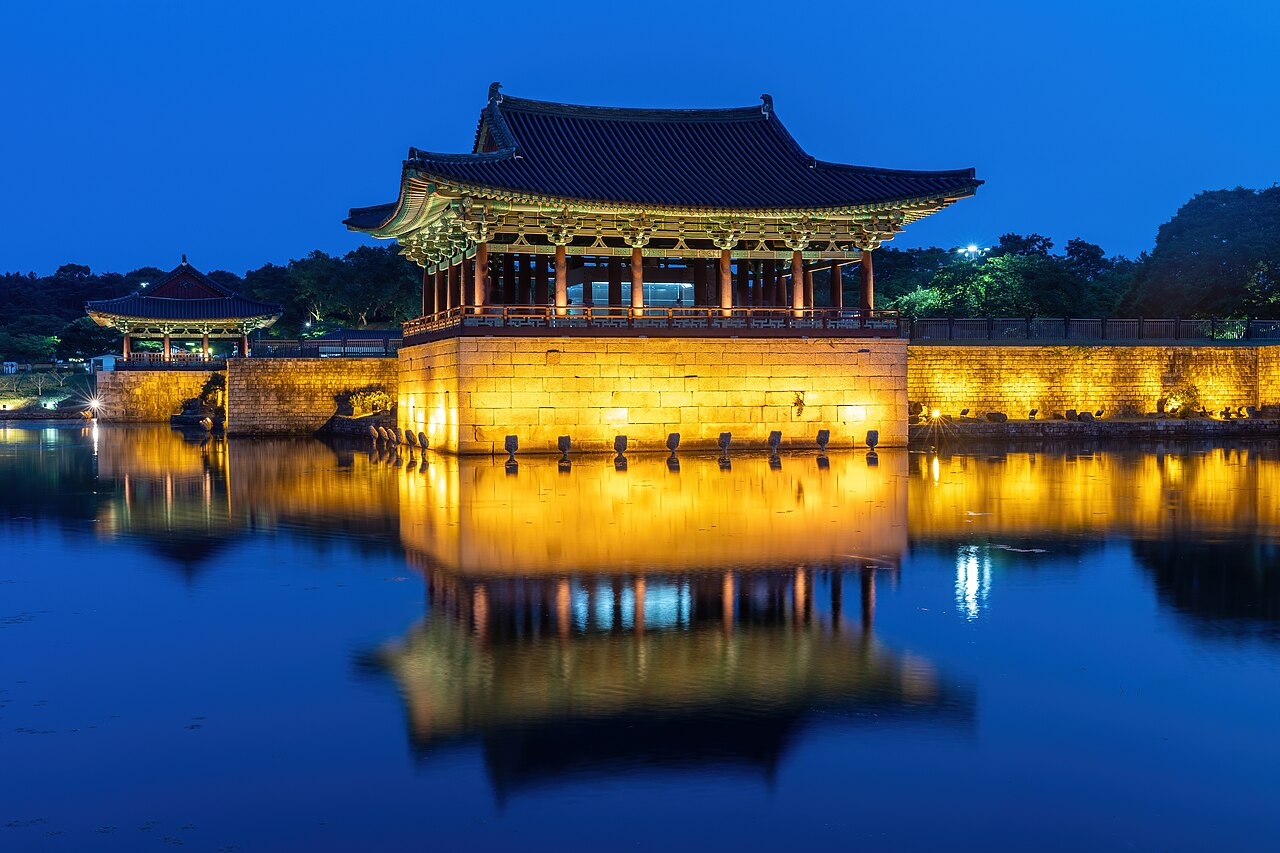
동궁과 월지 Donggung-gwa WoljiThe rebuilt pavilions of the crown prince's old palace are mirrored in the pond. At night they are lit up and the reflection is beautiful. Close by is Cheomseongdae (첨성대, Cheomseongdae), a 7th century stone observatory.
Find on map
What to eat
Ssambap Leaf wraps with rice
쌈밥 ssambapA table of fresh lettuce, perilla and cabbage leaves with many side dishes. You wrap rice, meat and doenjang (된장, doenjang) soybean paste in a leaf and eat it in one bite. In Gyeongju it is very popular near the tombs.
Find on mapChalbori-ppang Barley cakes
찰보리빵 chalbori-ppangTwo soft rounds made with glutinous barley, filled with lightly sweet red bean paste. It is Gyeongju's classic edible souvenir to take home.
Find on map
The tombs, Cheomseongdae and Wolji are close together on flat ground, so in the center you can get around on foot or by bike. Set aside half a day for Bulguksa and Seokguram.
Sources
Coreanda summarizes this guide in English. Each link shows the actual language of the external page.
- Gyeongju: heritage and modern walksSource language: EnglishKorea Tourism Organization · Source checked 2026-10-20Gyeongju Reimagined: From Silla’s Legacy to Modern Trends, opens in a new tab
- Ipungnyeo Guro SsambapSource language: EnglishKorea Tourism Organization · Source checked 2026-10-20Ipungnyeo Guro Ssambap, opens in a new tab
- KORAIL trains and reservationsSource language: EnglishKORAIL · Source checked 2026-10-20KORAIL trains and reservations, opens in a new tab
- Information from UNESCOSource language: Language not verified/en/list/736, opens in a new tab
- Information from UNESCOSource language: Language not verified/en/list/976, opens in a new tab
- Information from gyeongju.go.krSource language: Language not verified/tour/page.do?mnu_uid=4781&code_uid=1044, opens in a new tab
- Information from gyeongju.go.krSource language: Language not verified/tour/page.do?mnu_uid=4786&code_uid=1049, opens in a new tab
- Information from gyeongju.go.krSource language: Language not verified/tour/page.do?mnu_uid=4824&, opens in a new tab
- Information from KORAILSource language: Language not verified, opens in a new tab
- Information from en.wikipedia.orgSource language: Language not verified/wiki/Daereungwon, opens in a new tab