
Busan 부산
Mountains, beaches and Korea's biggest port
Get a feel for the place, then find your next stop on the map.
CITY / QUICK GUIDE
Your city at a glance
- A port city with different beach neighborhoods
- Gwangalli nights + gukbap the next day
Getting there from Seoul
Approximate journey times vary by service and exclude transfers, waiting and airport check-in.
A stop for your next itinerary
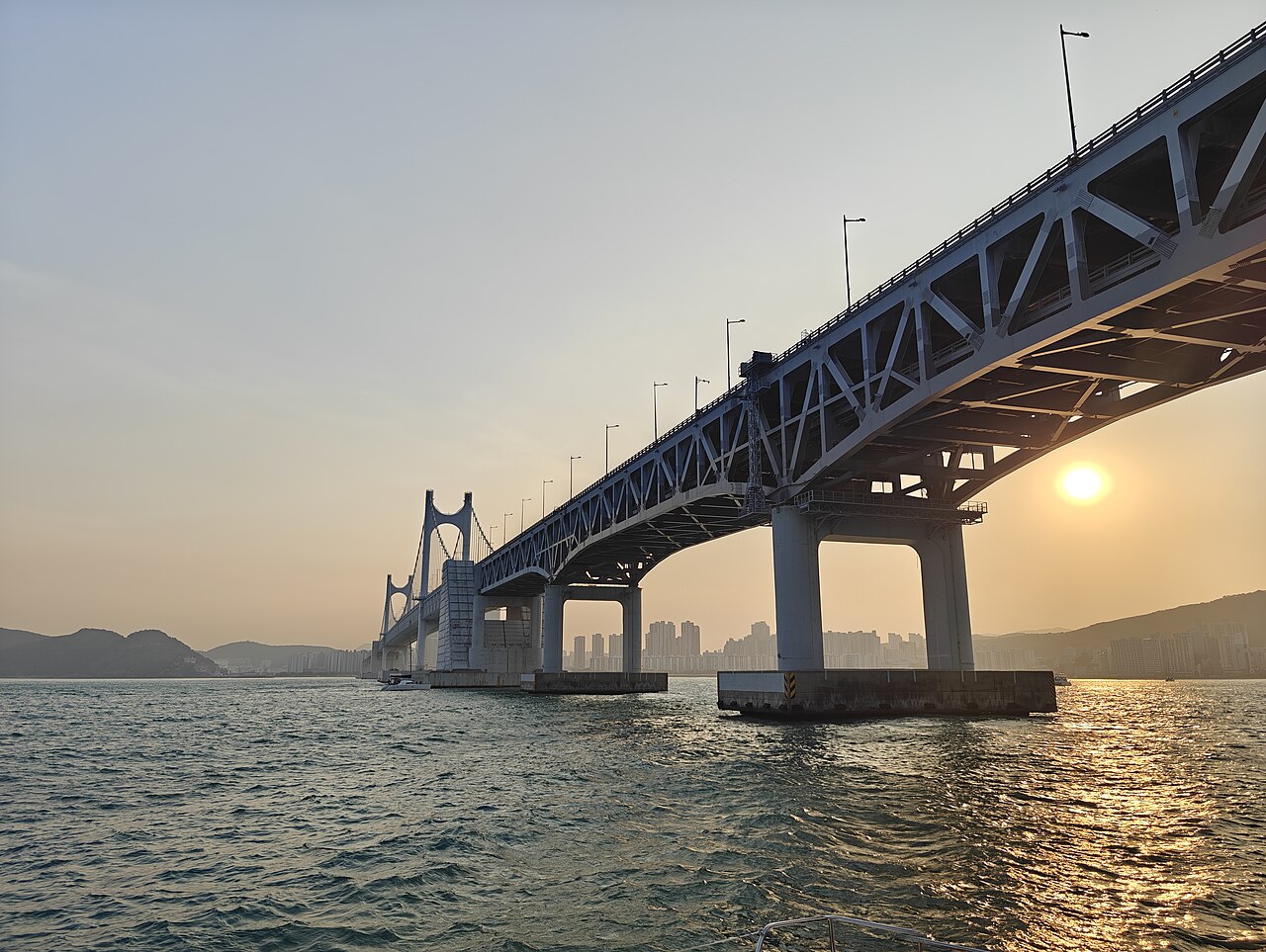
Gwangalli: walks, SUP and bridge views
Try the SUP zone by day and bridge views by night. Check the official drone program before visiting.
Ideas for all four seasons
Spring · Mar–May
Walk the coast in spring blossom season.
Summer · Jun–Aug
Try beach time or SUP with safe conditions and operators.
Autumn · Sep–Nov
Mix cinema, cafés and walks; check festival dates.
Winter · Dec–Feb
Take short coast walks and warm up over gukbap.
Where to eat: sourced places
We checked the linked listings, not today’s service. Confirm hours, menu, reservations and dietary needs before visiting.
Hapcheon Gukbapjip
합천국밥집
부산광역시 남구 용호로 235Source checked · 2026-10-20Read more about the city
Why go
Busan is Korea's second city and its great port. Houses climb the hills almost down to the sea, and in one afternoon you can go from a beach to a fish market to a neighborhood painted in bright colors. During the Korean War it was the temporary capital and took in huge numbers of refugees, a history you can still taste in its food.
What to see
Gamcheon Culture Village
감천문화마을 Gamcheon Munhwa MaeulPastel houses stepped up the hillside, which is why it is called the Machu Picchu of Korea. Korean War refugees built it, and since 2009 students, artists and residents have filled it with murals and sculptures. Entry is free, but people live here, so respect their peace.
Find on mapHaeundae Beach
해운대해수욕장 Haeundae HaesuyokjangKorea's most famous beach, wide and pale, about a 10 minute walk from Haeundae Station on subway Line 2. It is packed in summer; in autumn it is perfect for a sunset walk.
Find on mapJagalchi Market
자갈치시장 Jagalchi SijangBusan's most iconic fish market. On the ground floor you pick live fish, and on the second floor they prepare it for you. The rooftop deck looks over the harbor and Yeongdo Island.
Find on mapTaejongdae Park
태종대 TaejongdaeColorful rock cliffs and thick forest at the southern tip of Yeongdo Island. A little train loops through the park, and on clear days the lookout shows Japan's Tsushima Island. Below stands Yeongdo Lighthouse, lit since 1906.
Find on map
What to eat
Dwaeji-gukbap Pork and rice soup
돼지국밥 dwaeji-gukbapA thick, milky broth of pork bones with sliced pork and rice. You season it at the table with salted shrimp and chives. It is the dish that best represents Busan.
Find on mapMilmyeon Cold wheat noodles
밀면 milmyeonWheat flour noodles in cold broth or spicy sauce. They are said to have been born when refugees from the north adapted their cold noodles to the flour available during the war. Perfect in summer.
Find on mapEomuk Fish cake
어묵 eomukFried fish paste, on skewers or in a hot broth. Busan is famous for its eomuk, and you find it in almost every market.
Find on map
Jagalchi Market opens from 5:00 to 22:00 and closes on the first and third Tuesday of each month, and the Danubi train at Taejongdae does not run on Mondays (verified in October 2026). For Gamcheon, take subway Line 1 to Goejeong Station, use Exit 6 and ride the Saha 1 or Saha 1-1 village bus to Gamjeong Elementary School.
Sources
Coreanda summarizes this guide in English. Each link shows the actual language of the external page.
- Gwangalli BeachSource language: SpanishKorea Tourism Organization · Source checked 2026-10-20Playa Gwangalli (광안리해수욕장), opens in a new tab
- Gwangalli SUP ZoneSource language: SpanishKorea Tourism Organization · Source checked 2026-10-20Gwangalli SUP Zone (광안리 SUP Zone), opens in a new tab
- Official Gwangalli drone scheduleSource language: EnglishSuyeong-gu · Source checked 2026-10-20Gwangalli M Drone Light Show, opens in a new tab
- Hapcheon Gukbapjip: Michelin listingSource language: EnglishMICHELIN Guide · Source checked 2026-10-20Hapcheon Gukbapjip, opens in a new tab
- KORAIL trains and reservationsSource language: EnglishKORAIL · Source checked 2026-10-20KORAIL trains and reservations, opens in a new tab
- Information from Visit BusanSource language: Language not verified/en/index.do?menuCd=DOM_000000301001001000&uc_seq=365&lang_cd=en, opens in a new tab
- Information from Visit BusanSource language: Language not verified/index.do?menuCd=DOM_000000302011001000&uc_seq=2809&lang_cd=en, opens in a new tab
- Information from Visit BusanSource language: Language not verified/en/index.do?menuCd=DOM_000000301001001000&uc_seq=258&lang_cd=en, opens in a new tab
- Information from busan.go.krSource language: Language not verified/eng/beaches/1325815, opens in a new tab
- Information from busan.go.krSource language: Language not verified/eng/ai-translated-press-releases/1750864, opens in a new tab
- Information from KORAILSource language: Language not verified, opens in a new tab